7 Best After Hours Answering Services for 2026
It’s 9 PM on a Tuesday. A potential high-value client finally has time to call your business. They want to book, get a quote, or ask one last question...
It’s 9 PM on a Tuesday. A potential high-value client finally has time to call your business. They want to book, get a quote, or ask one last question before buying. They reach voicemail instead.
Some callers leave a message. A lot of them hang up and call the next company that picks up.
That is the actual after-hours problem. It is not just missed calls. It is missed revenue, slower response times, weaker customer trust, and a messy next morning for your staff. Businesses that still treat after-hours coverage like a front-desk backup usually end up paying for it somewhere else, in lost leads, manual callback work, or both.
The buying decision has changed, too. Owners used to choose between a live answering service and no coverage at all. Now there are three workable models. AI-first systems answer immediately, handle routine questions, qualify leads, book appointments, update the CRM, and keep the conversation going by text or email. Human receptionist services still earn their place when the call requires empathy, judgment, or detailed industry context. Hybrid setups fit companies that need automation for volume and people for edge cases.
Cost is part of that decision, but it should not be the only filter. Cheap coverage that only takes a message can still create cleanup work for your team. A higher-priced service can be worth it if it books the job correctly, captures intake details cleanly, and routes urgent calls the right way. I usually tell operators to compare systems based on what happens after the call, not just who answers it.
That is also why this list starts with model fit before provider fit. Some businesses need an AI receptionist tied closely to scheduling and follow-up, similar to how a 24/7 AI receptionist handles calls without sending buyers to voicemail. Others need trained humans because the caller is stressed, confused, or making a high-trust purchase. The wrong model creates friction even if the provider is reputable.
This guide compares seven strong options, but the more useful question is simpler. Should you buy labor, software, or a mix of both? The right answer depends on your call volume, sales process, customer expectations, and how much operational handoff your team can absorb the next day.
1. Glue Sky
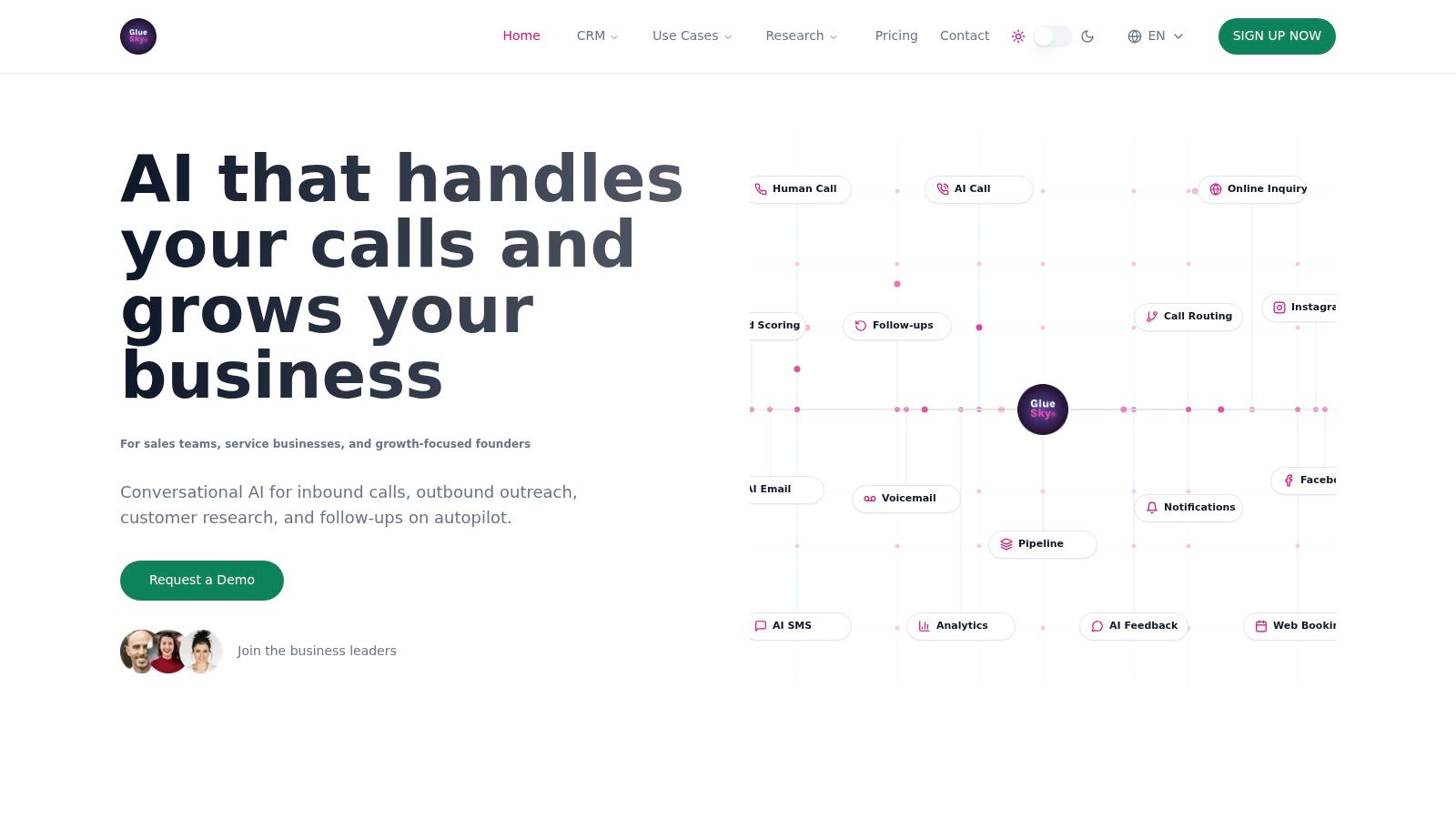
Glue Sky is the strongest fit here for businesses that don’t just want calls answered. They want after-hours conversations to feed a working sales and follow-up system.
That distinction matters. A lot of answering services are still built like outsourced front desks. Glue Sky is built more like an always-on communications layer tied to CRM, lead qualification, scheduling, and outbound follow-up. For growing teams, that’s usually the better operating model because the call is only the start of the revenue process.
Its platform covers voice, SMS, email, and social, with conversational agents handling inbound calls around the clock. It also supports 32+ languages, 100+ natural voices, and 50+ accents, which is unusually useful for service businesses and agencies serving mixed local markets or multilingual customer bases. If your after-hours setup only answers the phone but doesn’t drive the next step, you still end up doing too much manual rescue work the next morning.
Where Glue Sky stands out
Glue Sky makes the most sense for teams that need one place to manage contact history, routing, qualification, and pipeline movement. Clinics, salons, home services, real estate teams, and agencies tend to benefit quickly because their after-hours calls are often repetitive in structure but still revenue-sensitive.
Published pricing starts with a pay-as-you-go option at $99 per month, then a Starter plan at $199 per month, and a Professional or Team plan at $549 per user per month. That flexibility is helpful, but it also means you need to model expected usage realistically. If your business has heavy call volume, per-minute and per-message charges can push total spend above the headline plan price.
Practical rule: Glue Sky is a good buy when speed-to-lead and follow-up discipline matter more than having a human answer every conversation.
A few capabilities are especially relevant after hours:
- Omnichannel continuity: A lead can call at night, get qualified, receive follow-up by text or email, and land in the CRM without your staff rebuilding context manually.
- Operational visibility: Dashboards for conversion, response activity, and agent performance help ops teams spot bottlenecks instead of guessing.
- Built for scale: AI systems can handle simultaneous calls without the same staffing constraints as human-only models. That’s a real advantage for campaigns, busy seasons, and local service spikes.
Trade-offs to understand
Glue Sky is not the right answer for every call type. If your after-hours traffic includes emotionally charged support issues, legal nuance, or highly sensitive negotiations, you’ll still want clear human handoff rules.
That’s the part some buyers miss with AI. The goal isn’t to make the machine do everything. The goal is to let automation handle the repetitive, structured, and time-sensitive work faster than staff or live agents can. Then route edge cases to people.
The company says customers can save 10+ hours a week and lift conversions by up to 25%. Those are platform claims rather than third-party benchmarks, so I’d treat them as directional and verify them against your own workflow. What I do like is that the product is clearly designed around measurable operations, not just generic “we answer calls” positioning. You can also review how this model works in practice through Glue Sky’s take on a 24/7 AI receptionist.
For businesses that want the best after hours answering service as part of a larger growth system, Glue Sky is the most strategic option on this list.
2. Smith.ai
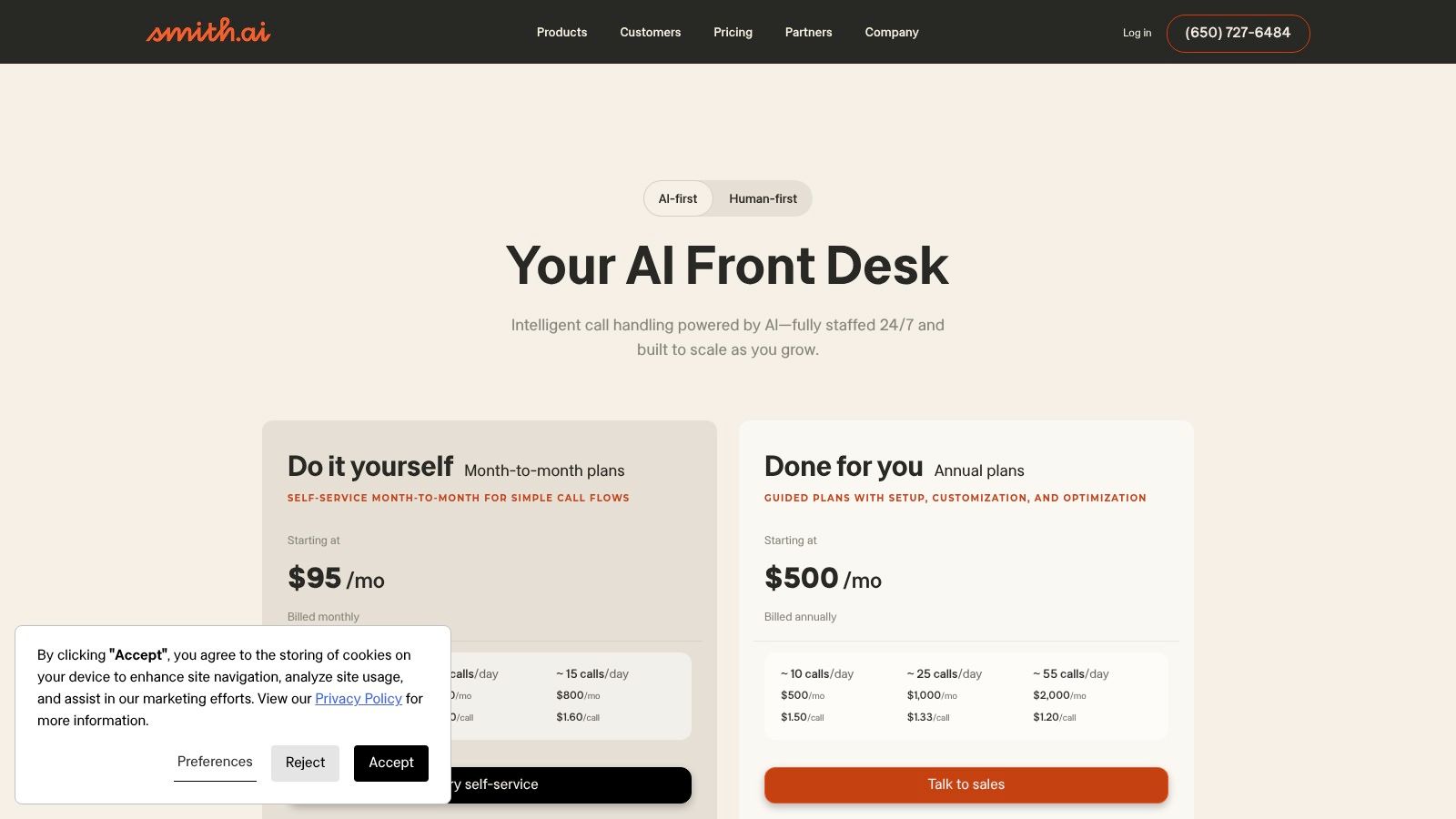
A prospect calls at 9:40 p.m. They want to know if you handle their case, what happens next, and whether they can talk to someone tomorrow. That call is too valuable for voicemail, but it also does not always require a fully staffed night team. Smith.ai sits in that middle ground.
That is why it stands out in this list. Smith.ai is less about picking AI or humans and more about deciding where each one should handle the work. For businesses that need after-hours coverage without handing every conversation to automation, that model can make sense.
Where Smith.ai fits best
Smith.ai combines AI receptionists with live agents, plus appointment booking, intake, lead screening, CRM and calendar integrations, and Zapier connections. In practice, that makes it a better fit for firms with a real intake process, not just a message-taking need.
I usually recommend this model to legal practices, consulting firms, med spas, and high-ticket home service companies. These businesses often get the same core questions after hours, but they also get edge cases where tone, clarification, or judgment affects whether the lead books or disappears.
A hybrid setup works well when you can define the line clearly. AI handles routine qualification, scheduling, and basic FAQs. Human agents step in for complicated callers, sensitive situations, or conversations that need reassurance.
The strongest hybrid systems assign clear jobs to AI and clear escalation rules to people.
The trade-off to examine
The upside is control. You get more automation than a traditional answering service and more judgment than an AI-only system.
The downside is cost creep on the human side. If your after-hours calls run long, involve detailed intake, or need frequent transfers to live agents, your monthly bill can climb faster than it would with an AI-first platform. That is a key decision point with Smith.ai. You are paying for a safety net, and for many businesses that is a smart expense. For others, it is overhead they do not need.
There is also some setup discipline required. Hybrid services perform best when scripts, routing rules, and escalation triggers are defined upfront. If your team is vague about what should be automated and what should be handed off, the service will feel inconsistent.
I’d shortlist Smith.ai if you want:
- A hybrid model: AI covers routine calls, live agents handle exceptions.
- Integration depth: Useful if leads need to move into calendars, CRMs, and follow-up automations.
- Stronger intake quality than basic message taking: Important when call handling affects booked revenue.
If your after-hours volume is mostly simple scheduling, status checks, or straightforward lead capture, a pure AI system will usually be cheaper and easier to manage. If your callers expect a smoother handoff between automation and a real person, Smith.ai is one of the more practical starting points.
3. PATLive
A customer calls at 9:40 p.m. because a job cannot wait until morning. They do not want a chatbot. They want a person who can listen, collect the right details, and make the business sound organized. That is the case for PATLive.
PATLive sits firmly in the human-first camp. That matters if you are comparing service models, not just brand names. Some companies need labor efficiency and tight automation. Others need a live receptionist because the caller is stressed, older, high-value, or less tolerant of automation after hours.
Why businesses pick PATLive
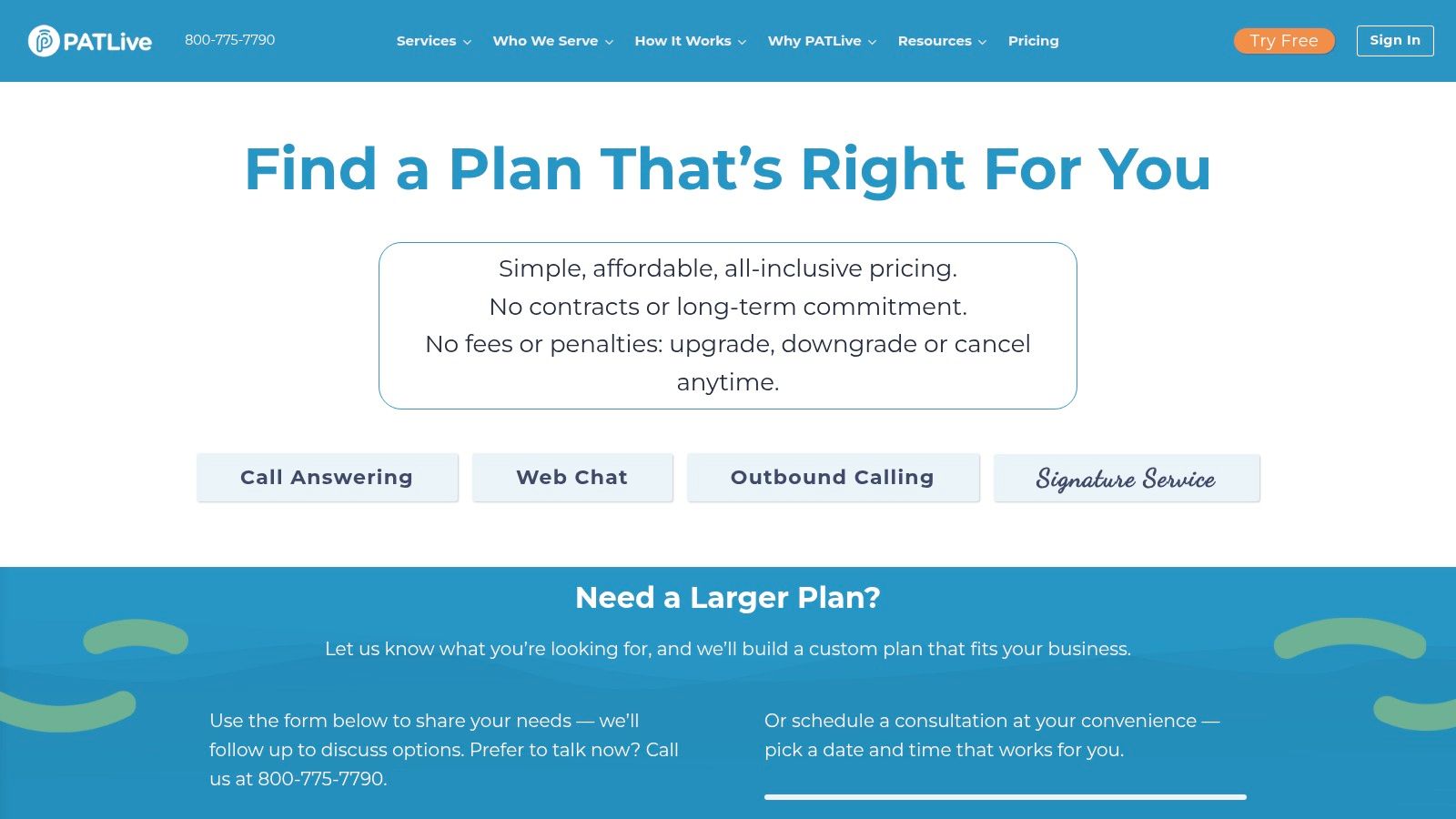
PATLive offers 24/7 live receptionist coverage, web chat, appointment scheduling, lead capture, order entry, call summaries, and optional outbound calling. The appeal is operational clarity. A business owner can understand what the service does without sorting through a complex AI workflow builder or a custom enterprise quote.
I usually see PATLive fit best where the script is clear but the conversation still benefits from a real person. Home services, legal intake, property management, and smaller medical or professional offices often land here. The business gets coverage that feels personal, and the setup burden is lower than an AI-first system that needs careful training, testing, and exception handling.
That simplicity has value.
The main trade-off
The trade-off is labor cost. Human answering services are easy to justify when missed calls are expensive, but they get expensive themselves as call minutes rise, scripts get more detailed, or callers need transfers and back-and-forth conversation. If you have not measured that math yet, start with the true cost of a missed call after hours, then compare it against what live coverage will cost at your call volume.
PATLive publishes pricing, which I consider a positive. You can review current plan structure directly on the PATLive pricing page instead of relying on vague sales language. The practical question is not whether the entry plan looks reasonable. It is whether your after-hours calls stay short and consistent enough to keep the monthly bill under control.
That is where the AI versus human decision becomes clearer. If most calls are routine, such as scheduling, simple FAQs, or basic lead capture, an AI-first model usually handles them for less. If callers need reassurance, clarification, or a warmer first impression, PATLive is often the safer choice even at a higher cost.
PATLive makes sense when these conditions apply:
- You want a real receptionist on every after-hours call.
- Your call flow is stable enough to script well.
- You prefer transparent packaging over a heavily customized setup.
Use more caution if your calls regularly run long, if demand spikes hard by season, or if your team expects deep CRM actions and multi-step follow-up from the answering layer. PATLive is a solid traditional service. It is not the right model for every company, and that is the point. If your business still wins more from human trust than from automation efficiency, PATLive deserves a serious look.
4. AnswerConnect
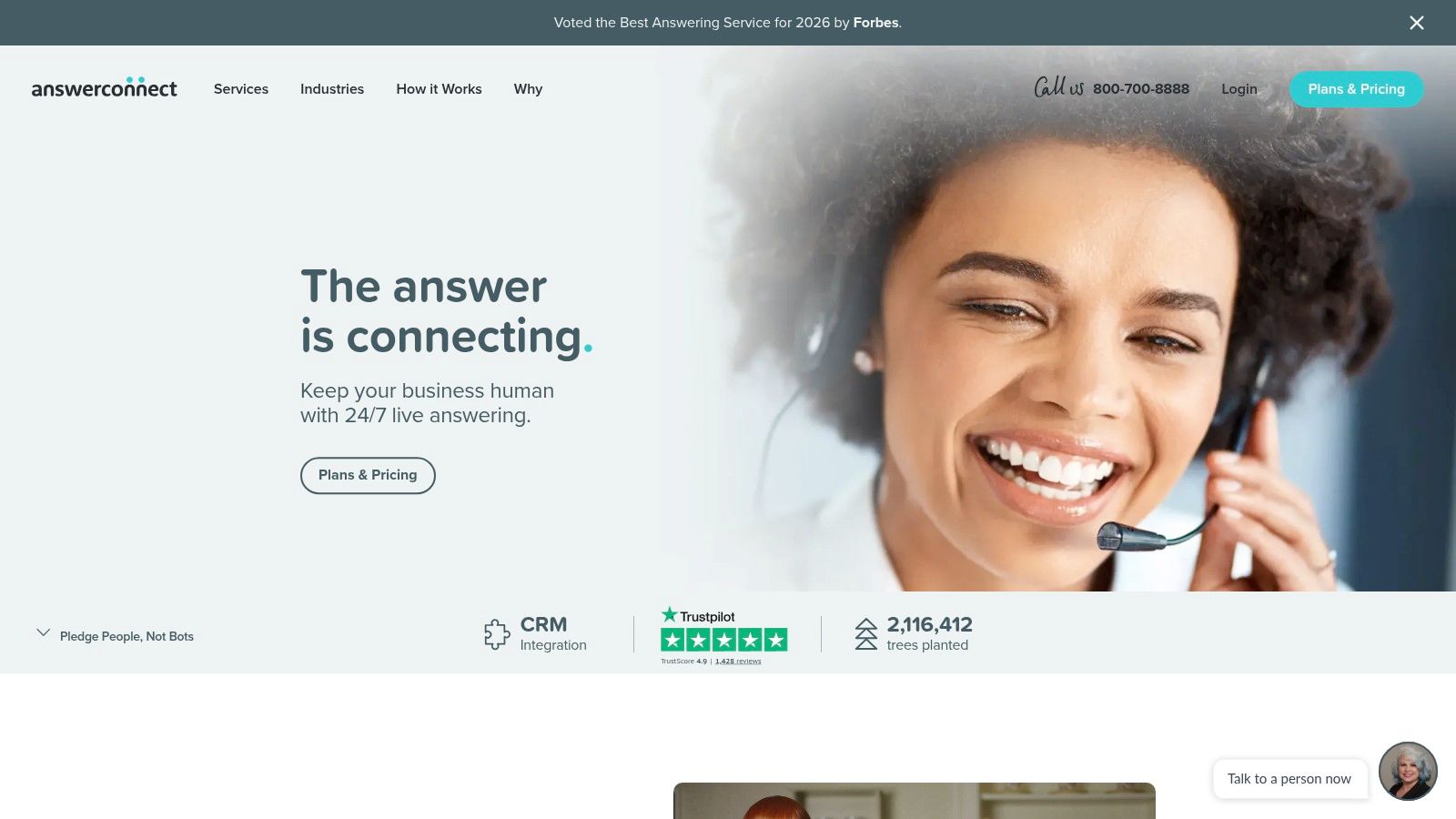
AnswerConnect is one of the clearest picks for businesses that want traditional live coverage and don’t want to experiment with AI at the front line.
That’s still a legitimate decision. For some brands, especially those in healthcare, law, and high-trust service categories, the caller’s first impression matters enough that a human-only model is worth the premium.
Best use case for AnswerConnect
AnswerConnect combines round-the-clock live answering with appointment booking, lead qualification, custom scripts, and integrations like Salesforce and Zendesk. Client reviews referenced in market summaries emphasize 24/7 coverage and operational reliability, while Forbes gave it a #1 ranking for 2025 among reviewed services in that source set, with minute-based plans beginning at $49 per month.
There’s a big caveat, though. The low entry point in a pricing sheet is not the same thing as a realistic monthly bill for full after-hours receptionist coverage. In practice, many human-led services climb quickly as minutes and complexity rise.
If your business loses meaningful revenue from missed calls, it’s worth reading Glue Sky’s perspective on the true cost of a missed call. The point isn’t that human service is wrong. It’s that the economics of missed demand usually matter more than the sticker price.
A live receptionist is easiest to justify when one booked matter, patient, or client easily covers the monthly service cost.
Real trade-offs
AnswerConnect’s strongest attribute is human consistency at scale. It also bundles live web chat in many plans, which makes it more useful than a phones-only vendor.
Its weak spot is the same weak spot most live services have. Costs rise with usage, and pricing visibility isn’t always as clean as buyers want before talking to sales. That can slow decision-making for leaner teams.
Choose AnswerConnect if you want:
- A human-first caller experience
- Custom scripts and appointment support
- Phone and chat coverage under one provider
Skip it if your main goal is aggressive cost efficiency, automated qualification, or multichannel follow-up after the call. For that, AnswerConnect is often less complete than an AI-first platform.
5. Ruby
Ruby is the premium human option on this list. If brand tone, polish, and caller experience are your top priorities, Ruby stays near the top of many shortlists for a reason.
This is not the budget play. It’s the “our phones are part of our brand” play.
Where Ruby earns the price
Ruby is commonly chosen by professional services firms that care about how calls feel, not just whether they get answered. Its mobile app, custom instructions, routing, and workflow documentation all support a more curated receptionist experience than many lower-cost live providers.
That matters in businesses where after-hours calls aren’t just transactional. A legal prospect, a medical caller, or a high-ticket consulting lead may judge your professionalism almost entirely from that first interaction.
There’s also a strategic question here that owners should answer thoughtfully. Do you need warmth and polish, or do you need speed, coverage, and systemized follow-up? Those aren’t always the same purchase. For a broader side-by-side on that decision, Glue Sky’s AI receptionist vs human guide is worth reviewing.
Where Ruby can frustrate buyers
Ruby’s biggest friction point is that pricing isn’t fully transparent publicly, and it’s usually positioned above more utility-focused competitors. That makes it harder for cost-sensitive teams to forecast quickly.
There’s also the scale question. Human services remain one-conversation-at-a-time operations. AI systems can handle simultaneous call volume without degradation, and some AI-first providers are positioned for unlimited concurrency. If your business gets bursts of calls from ads, emergencies, or promotions, that difference matters operationally.
If your reputation depends on sounding polished in every interaction, Ruby can be worth the premium. If your main problem is call volume, it usually isn’t the most efficient answer.
Ruby is best for:
- Professional services and brand-sensitive businesses
- Teams that want mature live receptionist workflows
- Owners willing to pay more for a refined human experience
It’s less attractive if you want highly measurable, automation-heavy after-hours revenue operations. Still, for a certain buyer, Ruby is exactly the best after hours answering service because it prioritizes presentation over pure efficiency.
6. Nexa
Nexa is a strong option when industry workflow matters as much as call handling itself.
A generic answering service can take a message. That’s easy. The harder job is handling intake, scheduling, dispatch, and escalation in a way that fits home services, healthcare, or legal operations. Nexa leans into that operational side better than many generalist providers.
Best fit for Nexa
Nexa works well for businesses that need vertical-specific scripts and processes, especially where after-hours calls can turn urgent fast. Home services companies, clinics, and legal practices often need more than “someone answered.” They need someone who knows what qualifies as urgent, what gets scheduled, and what gets routed where.
Its offer includes live answering, dispatch, intake, scheduling, outbound support, analytics, and integrations with tools such as ServiceTitan and HubSpot. That makes it more useful than a basic receptionist service when the phone call is tied to real field or intake operations.
What to watch before buying
The challenge with Nexa is forecasting. Site plan structures are published, but standard dollar pricing isn’t always displayed in a way that makes quick comparisons easy. Setup rules and billing logic can also make total monthly cost less intuitive than buyers want.
That doesn’t make Nexa a bad choice. It just means you should model actual call patterns before signing. If your after-hours workflow depends on dispatch and vertical nuance, that extra diligence is worth it.
Recent industry commentary also points to a broader integration issue across the category. Poor integrations can lead to fragmented histories and missed leads, while AI-first platforms are increasingly emphasizing faster onboarding and more reliable sync with CRM workflows, according to this integration and ROI discussion. That doesn’t invalidate Nexa. It does mean any provider in this category should be tested on data flow, not just phone etiquette.
I’d shortlist Nexa if you need:
- Industry-specific intake and dispatch
- Live agents who can follow structured escalation paths
- A stronger operational fit than generic message taking
For vertical businesses that need specialized handling, Nexa is one of the better human-led options.
7. ReceptionHQ
A prospect calls at 9:40 p.m. They do not need a full intake sequence. They need a person to answer, capture the issue correctly, and make sure the call does not die in voicemail. That is the job ReceptionHQ is built for.
ReceptionHQ fits businesses that want live after-hours coverage without committing to a heavier operating model. I see it as a practical entry point for smaller companies, newer service firms, and teams that have not yet earned enough after-hours volume to justify AI workflow design or a more involved human intake setup.
Where ReceptionHQ makes sense
The value here is straightforward. ReceptionHQ offers live agents, 24/7 availability, message-taking plans, receptionist plans, call transfers, voicemail-to-email, SMS alerts, and month-to-month terms. That combination lowers the buying risk for owners who need coverage now and want room to adjust later.
This is the core trade-off. AI-first services usually win on automation, speed, and lower cost at scale. Human-led services still win when callers expect empathy, reassurance, or a natural conversation. ReceptionHQ sits on the human side of that decision, but at the lighter end of the category. It is a fit for businesses that need missed-call protection more than process automation.
That distinction matters. If your after-hours goal is to make sure every caller reaches a live person and your office gets a clean message the next morning, ReceptionHQ can do that job well.
Where it falls short
ReceptionHQ is not the right pick for companies that want the phone channel to run like an automated revenue system. It is less compelling if you need lead qualification rules, CRM-triggered workflows, appointment logic across multiple systems, or consistent multistep handling by call type.
I would be cautious if your team is already struggling with manual follow-up. A basic receptionist layer can stop missed calls, but it does not remove much downstream admin work. Someone on your staff still has to review messages, qualify intent, and push the next action.
Use ReceptionHQ when:
- You want live after-hours coverage with low commitment
- Your main need is message capture, call routing, or simple forwarding
- You want to test human answering before investing in a more advanced model
Avoid it if your priority is reducing admin load, automating qualification, or connecting phone conversations to broader customer communication workflows. In that case, ReceptionHQ may feel too limited.
Top 7 After-Hours Answering Services Comparison
| Item | Implementation complexity | Resource requirements | Expected outcomes | Ideal use cases | Key advantages |
|---|---|---|---|---|---|
| Glue Sky | Medium, AI voice setup, tuning and CRM integration | Moderate–high: per-minute/SMS costs, onboarding and integration effort | 24/7 automated outreach, faster follow-up, reported time savings and conversion lifts | Sales teams, service businesses, real estate, multilingual outreach, voice-first campaigns | Omnichannel AI agents, built‑in CRM, extensive language/voice support |
| Smith.ai | Low–Medium, select hybrid tier and configure integrations | Variable: per-call or AI-tier fees, CRM/calendar integrations; some customizations may need annual plan | Reliable after‑hours coverage with human backup and cleaner handoffs | Teams wanting AI receptionist with human fallback and deep integrations | Human backup + AI tiers, strong integrations, published per‑call pricing for AI |
| PATLive | Low, straightforward minutes/pool setup and onboarding | Moderate: minutes‑based plans, possible bilingual/add‑on costs | Predictable live coverage, inclusive task support and call summaries | Organizations preferring predictable minute pools and all‑inclusive human support | Transparent minutes plans, all‑inclusive features, no long‑term contract |
| AnswerConnect | Low, standard onboarding with app and integrations | Moderate: minutes‑based billing, sometimes setup fees | Consistent human answering with bundled web chat and scalable tiers | Teams needing bundled phone+chat and month‑to‑month scalability | Bundled phone+chat, scalable plans, established provider with onboarding |
| Ruby (Ruby Receptionists) | Medium, consultative onboarding and custom workflows | Higher: typically premium pricing, sales consult for plans | High‑quality, brand‑sensitive live answering and polished caller experience | Professional services and businesses prioritizing brand‑focused live answering | Strong reputation, mature tooling, industry playbooks and tailored support |
| Nexa | Medium, setup for vertical workflows and CRM integrations | Moderate–high: minute plans, custom setup fees, integrations | Industry‑specific intake, dispatch and scheduling with vertical workflows | Home services, healthcare, legal and businesses needing dispatch/vertical expertise | Vertical specialization, outbound follow‑ups, industry tool integrations |
| ReceptionHQ | Low, simple sign‑up, message‑only or full plans | Low: very low‑entry options, month‑to‑month pricing; add‑ons may apply | Affordable after‑hours message coverage with flexible upgrades | Small businesses seeking low‑cost after‑hours messaging or light coverage | Low entry pricing, flexible subscriptions, clear upgrade paths |
From After-Thought to Asset Making Your Choice
At 9:17 p.m., a prospect calls, gets voicemail, and moves to the next company. By 9:20, your competitor has the job on the calendar. That is the cost of treating after-hours coverage as an admin task instead of a revenue process.
The right decision starts with the model, not the brand name. Human-first services still earn their place when callers are upset, confused, or making a high-trust purchase. AI-first systems win on speed, consistency, and follow-up discipline. Hybrid setups work well when you want routine calls qualified and routed automatically, with people handling edge cases.
That choice changes both cost and operating complexity. A live receptionist service can protect your brand on sensitive calls, but minute-based pricing climbs fast if call volume is uneven or your scripts require long handoffs. AI systems usually handle spikes better and keep records cleaner, but they need tighter setup, better prompts, and clear escalation rules. Businesses looking beyond message taking often pair after-hours phone coverage with automated lead generation so the inquiry does not stop at a transcript or callback note.
I usually frame the decision around what has to happen after the call is answered. If the goal is to capture a name and number, a lower-cost human service may be enough. If the goal is to qualify leads, book appointments, send confirmations, and update the CRM before staff clocks in, AI-first has a clear advantage. That is the difference between coverage and workflow.
Provider fit follows from that operating choice. Ruby and Nexa make sense when the conversation itself carries high value and the caller experience affects close rates. AnswerConnect and PATLive fit companies that want live coverage with broader utility and fewer premium frills. ReceptionHQ is a practical entry point for basic message handling. Glue Sky is notable for businesses that want after-hours calls to trigger qualification, booking, routing, and follow-up inside one system instead of creating a queue for the morning.
Use a simple filter.
- Lead capture and fast follow-up: AI-first or hybrid
- Appointment booking with calendar or CRM updates: AI-first, or a live service with solid integrations
- Basic message taking: human-first is often enough
- Emergency triage or complex intake: human or hybrid
- Large call bursts after ads, storms, or weekend demand: AI-first
The best after hours answering service matches your growth stage, customer expectations, and tolerance for operational overhead. A small local business may start with affordable live coverage and upgrade later. A company spending heavily on ads usually needs automation sooner, because speed-to-lead matters more than perfect phone manners. If voicemail is still your default, fix that first.
If you serve a field-service audience and want another industry-specific angle, this overview of after-hours solutions for cleaning companies is a useful companion read.
If you want after-hours coverage that does more than take messages, Glue Sky is worth a serious look. It combines AI voice, SMS, email, social messaging, lead qualification, booking, and CRM visibility in one system, which makes it a strong fit for businesses that want missed calls to turn into tracked opportunities instead of morning callbacks.